
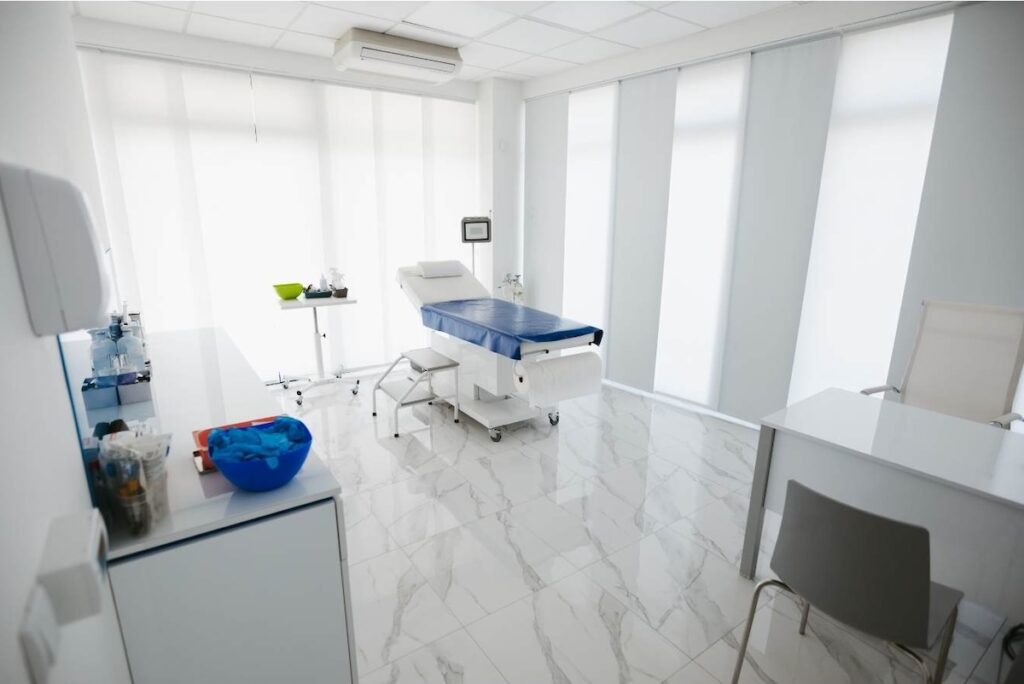
Cosmetic surgery is moving out of hospitals and into office-based suites at a pace that most surgical device distributors haven’t fully priced into their sales strategy.
Who makes the purchasing decision, what the OR looks like, and what they need from lighting all differ from hospital or ASC settings in ways that change the entire sales approach.
This article covers:
- how fast the shift is happening and which procedures are driving it
- how office-based buying behavior differs from hospital procurement
- what accreditation requires from surgical lighting in these settings
- how to position yourself for a market where the surgeon is also the owner
- the advantages of portable equipment like the koplight™
Distributors who understand how this market works sell into it; those who don’t keep calling on the wrong people with the wrong pitch.
Contents
How fast is cosmetic surgery moving into office-based settings?
The shift is already well advanced. A review in Plastic and Reconstructive Surgery – Global Open found that an estimated 82% of cosmetic plastic surgery procedures are performed in outpatient settings. The trend has continued since.
The three most common cosmetic surgical procedures are also among the most commonly performed in office settings. ASPS 2023 statistics show liposuction (347,782 procedures), breast augmentation (304,181), and abdominoplasty (170,110) at the top of the 2023 count, all deep-cavity procedures under local or conscious sedation, where overhead lighting often falls short of what surgeons need inside the cavity.
For accredited facilities, the safety data runs counter to the setting’s old reputation. A large outcomes study reviewed 183,914 aesthetic surgical procedures across three settings and found that office-based surgical suites had a major-complication rate of 1.3%, compared with 1.9% in ASCs and 2.4% in hospitals, the lowest of the three, both differences statistically significant.
That finding holds specifically for accredited offices, which is why QUAD A and AAAHC accreditation have become the practical entry standard in this market. The Aesthetic Society reports 10.2% growth in cosmetic surgical procedures from 2019 to 2023. Distributors without a dedicated office-based surgery channel are watching a fast-growing segment pass them by.
How does an office-based OR differ from a hospital or ASC setting?
The surgeon is usually the owner, and that changes how purchasing decisions get made.
In hospital and ambulatory surgical center (ASC) settings, a value analysis committee, a group purchasing organization (GPO) contract, and a sterile processing department (SPD) compatibility review all sit between a surgeon’s preference and a purchase order. In an office-based practice, the surgeon-owner makes the call. A practice manager may be involved, but there’s no committee to clear and no SPD manager whose sign-off can block the deal.
The financial structure is also distinct, as the US CMS doesn’t govern office-based surgery, and most third-party payers won’t reimburse a facility fee to office-based practices. Revenue comes from professional fees alone. That means capital equipment competes directly with practice cash flow or financing, with no facility-fee buffer. Equipment decisions get made faster but with more direct attention to per-case economics.
The regulatory environment is lighter than it looks from the outside. A peer-reviewed review of office-based plastic surgery guidelines noted that as of 2022, fewer than 30 US states had laws governing office-based surgery, and even fewer required accreditation. Where accreditation is required or chosen, QUAD A and AAAHC are the two principal bodies, and their lighting requirements are more specific than most distributors expect.
What do office-based settings require from surgical lighting?
Accreditors require functioning lighting and mandatory backup power, not a specific lux level.
QUAD A’s current accreditation standard (Standard 4-B-3) requires that the operating room have “functioning lighting in the ceiling based on the types of cases performed,” with access to battery-powered illuminating systems. The emergency backup must activate immediately if battery-powered or within 10 seconds if generator-based. QUAD A does not specify a minimum lux level; it defers to the device standard.
The device standard that governs ceiling-mounted surgical luminaires is IEC 60601-2-41, which sets central illuminance at 40,000–160,000 lux with a color rendering index between 85 and 100. QUAD A defers to applicable device standards rather than setting its own lux minimum, so a properly cleared overhead light satisfies the accreditation requirement without needing a facility-level number. Some lighting systems fall under separate device clearance pathways, since IEC 60601-2-41 explicitly excludes lights connected to surgical instruments.
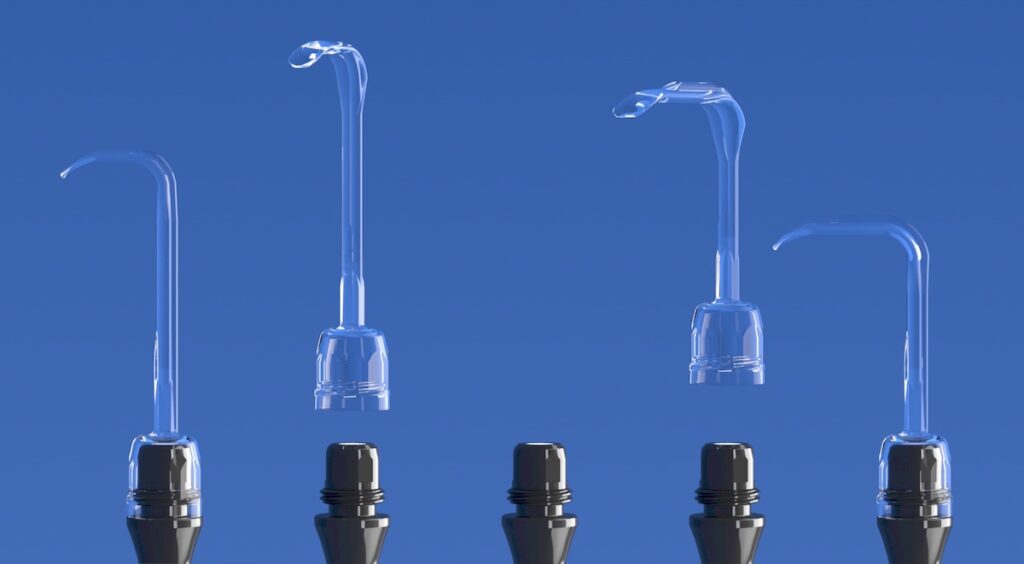
Breast augmentation, liposuction, and abdominoplasty all involve working inside cavities where ceiling lights cast shadows and require frequent repositioning. A retractor-mounted LED system that moves with the instrument delivers illumination where the dissection is happening. In an office OR with a single overhead unit, that difference shows up on every case.
Sterilization in office settings runs on tabletop steam autoclaves, with cycle times in the range of a few minutes at 132–135°C. EtO sterilization isn’t practical in office settings. That reprocessing reality favors single-use blade systems, since the blade contacts tissue and is discarded after the case instead of going back through reprocessing. Research in acute care hospital settings has found that immediate-use steam sterilization, used when reprocessing time runs short, is associated with a 1.52× higher surgical site infection risk. Surgeon-owners who bear the full clinical and financial consequences of an SSI have a stronger incentive than most to simplify that reprocessing chain.
The koplight™ fits this environment. The single-use blade is discarded after each case, so only the light handle and its accessories need reprocessing, and there’s no fiber optic cable or light source to clean. The light handle is sterilized with low-temperature hydrogen peroxide or ethylene oxide, and the finger hook and battery inserter can also go through steam.
How should distributors approach the office-based cosmetic surgery market?
Sell to the surgeon-owner with a per-case cost argument, not a capital budget argument.
The surgeon-owner has a clear line of sight between what each procedure costs to run and what it generates. A widely used rule of thumb in cosmetic practice management frames consumable and device carrying costs as less than 25% of the total procedure fee. If you can anchor your pitch in that framework, demonstrating cost per case rather than total acquisition price, you’re making an argument the owner-operator can act on immediately. That’s a different meeting than the one you’d have with a hospital procurement committee.

Bring IFU documentation, IEC compliance data, and a per-case blade cost calculation. QUAD A and AAAHC accreditors review equipment during surveys, and handing the surgeon documentation they can show an accreditor is something most reps never do. The surgeon-owner remembers the distributor who helped them pass the accreditation survey, not the one who left a brochure.
The Aesthetic Society Annual Meeting and ASPS Plastic Surgery The Meeting are the two primary venues where board-certified cosmetic surgeons convene. QUAD A accreditation events attract specifically the office-based segment, often including practice managers who hold real influence over equipment decisions. These channels are considerably more productive than general medtech distribution for a product positioned at the OBS cosmetic market.
For distributors presenting the koplight™, especially in the US and Europe, the pitch centers on operational fit. It’s FDA-registered, EU MDR-certified, with an IPX-7 waterproof rating (1 m water depth for 30 min; tail cap should be firmly tightened), single-use blades, and standard AAA batteries.
The koplight™ for office-based surgical suites
The koplight™ is a cordless LED lighted retractor built for the reprocessing and space constraints of accredited office-based ORs. Manufactured in Japan and available for distribution. Distributors selling into office-based cosmetic surgery accounts can contact Yasui directly.
